Forum Replies Created
-
AuthorPosts
-
Here is what it looks like on my video title screen. I think it looks great.
Attachments:
I’d like to use the two images at the end of page two of this forum (monkey no number). Will appear in my next video.

Good work.
Hi,
I’ve been recovering from surgery but have managed to get a demo featuring Alien Phoenix nearly ready for release. It’s just a simple tech demo but should give users a good early glimpse of what the framework is capable of. I’ll be releasing it for Linux and HTML5 in a few weeks.
Check out the video.
I have been working on a scripting framework and at this point in Reflection’s development I’m thinking it’s just easier to encapsulate class types into a separate class (‘s). In addition to nonsupport of generic types there are some other issues for example this is not supported in reflection.
Monkey1234Add(var1:Int, var2:Int)Add(var1:Float, var2:Float)Add(var1:String var2:String)The absence of generic type support leads to abstracts which support the script. This makes it difficult to support a user type and requires a lot of overhead. I’m still experimenting and I’ll be posting what I come up with, but it’s looking like Reflection at present is a less then perfect option runtime wise.
Reflection appeals to me in that when parsing script (more like source code in this case) I can easily invoke a method or function that is exposed to Reflection. This includes all of the public portions of my code as well as included modules and source imports. I have tinkered with scripting a bit and chose to use a contained variable approach where the variables are always included between parentheses even when initializing a variable. Something like myrect:= New Rect becomes CreateRect(Name) in script. This approach makes parsing (I guess tokenizing as well) easy and as long as I have a corresponding method or function ( like CreateRect() ) and handling generic types like Vec2() can be accommodated. In Vec2()’s case I would expect to use Vec2(var-name, va1, var2) in script where var-name is the invoked type (rect for example).
The downside is features like For/Next loops or adding, subtracting become difficult and more complex to implement. In the case of addition something like Add(var-name,var,var) where var-name is receiving the product of the addition. For loops like For/Next something like this script might work:
Monkey12345678CreateInt(my-int)CreateInt(myadd1-int)CreateInt(my-var-int)Value(myadd1, 10) 'variable equals variableLoopStart(my-int, 1, 100) ' variable name and then iteration variables.Add(my-var-int, my-var-int, myadd1-int)LoopEnd()This simple script illustrates my interest in Reflection and why I think it could be useful for scripting. The potential for easy parsing and processing of script using Reflection seems to me to be possible. Combined with an easy to learn and use scripting language I can imagine Reflection making the above possible.
I can totally relate. Medical stuff has been getting me of late.
We’re here to support ya the best we can.
You take that back!

Very courteous response. Let’s make that the norm.
Yes, I will pay that $100 when it’s out! Who will join me?
I’ll up my pledge another $5 a month. It’s what I can do for now, but I’ll be making more room in my budget to support Mark’s wonderful progress and support.
So yeah I’ll need it too and will gladly pay for it as it is logical to me to pay for some little things although I’m a backer from the early days.
I can’t help thinking (even with Mark’s time and workload constraints) that an IAP module might be a candidate for a Patreon goal. Just like the goal set for 3D. That way it’s at least on the menu for future development. I would be willing to up my pledge just to have the IAP option.
There is also the option to community code it. But, someone will need to take the lead and at least start a project thread here on the site and start organizing it.
Thanks for adding embed site support. +1.

This multi platform thing is still #1 “selling” argument for Monkey 1/2
I think that it is about demand and focus. There is no doubt that at least Android is a mobile target that will be part of Monkey 2. I think Mark’s point is that he needs to focus on where the demand is currently. It does not mean dropping the target but supporting what is in demand and then expanding targets like Android when time becomes available.
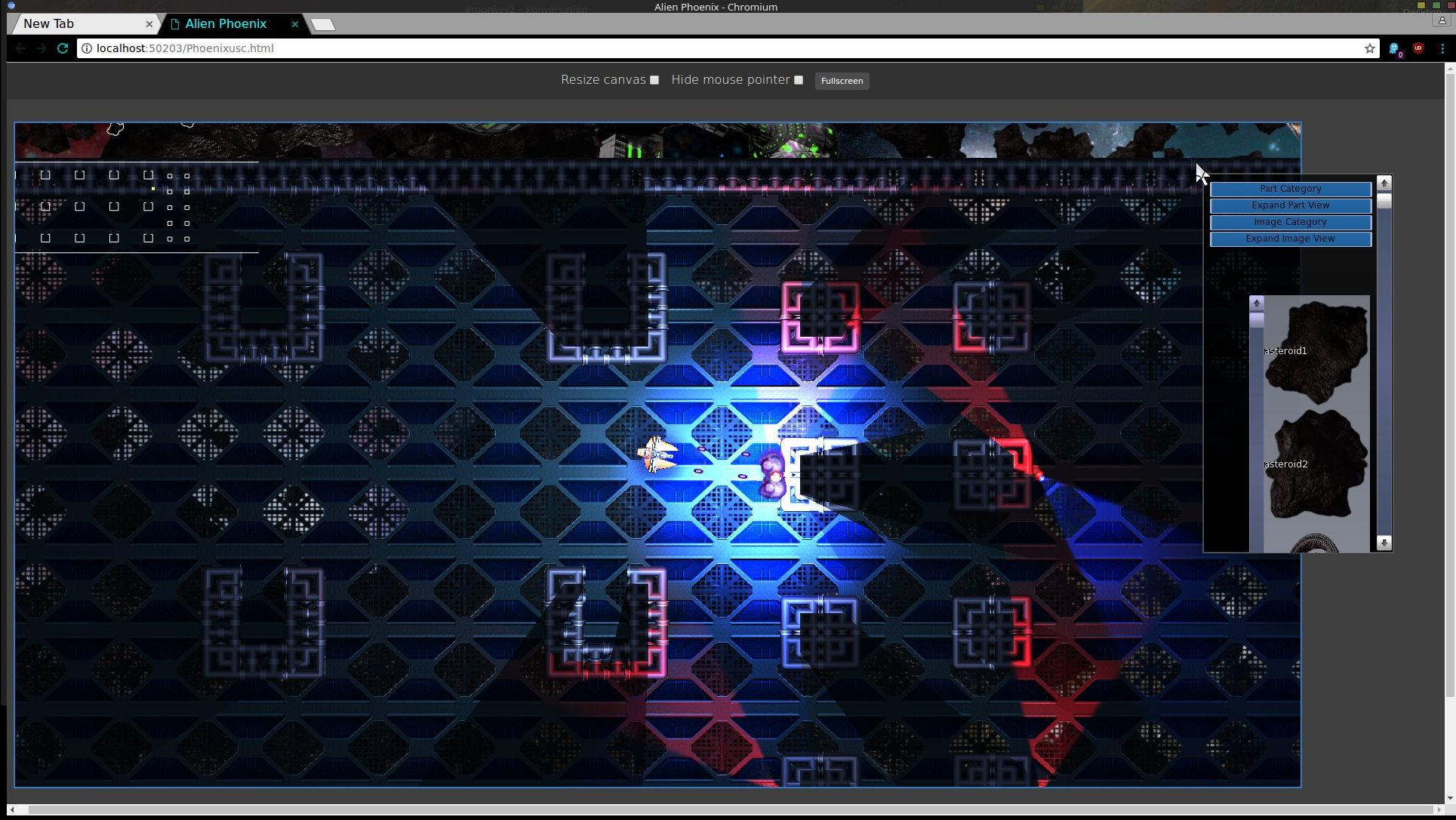
Attached is an image of Alien Phoenix running in the Chromium web browser at 60 FPS! With full support of Alien Phoenix’s windows based GUI. I’m sort of blown away that it is running so well and it is pretty cool to have a window based GUI in a web browser. I’m using the same test bed application with a lighted map as before. Amazing!
Is there anything Monkey 2 can’t do?
Attachments:
Attached is an image of mojox running with Alien Phoenix’s GUI. Pretty cool that both can exist within the same app instance. Alien Phoenix’s GUI is based on canvas as the anchor but perhaps I can somehow modify things to support a View. It might be possible through some kind of View z-order to then have mojox components like the tree view seen below work within an Alien Phoenix window.
Fun with Monkey 2!
Attachments:
I’m there as Vidiot_X. Linux and IRC go together like peanut butter and jelly.
Ted2GO rocks!Hi,
I have setup a repository for the Alien Phoenix gaming framework on Github located here. I hope to have code posted in a week or so. More information soon.
Rich
the only issue is high amounts of traffic, it seems to crash under heavy load
I’ve not tried to use the communications features of Monkey2 yet but I’ve had a similar problem with BlitzMax where over saturating a connection will cause a problem. The solution as I recall was to limit client/server interactions (timing between packets) to 50-60 milliseconds per connected client. I was using UDP at the time but I suspect TCP would benefit form the delta throttling.
-
AuthorPosts