Forum Replies Created
-
AuthorPosts
-
progressing quickly
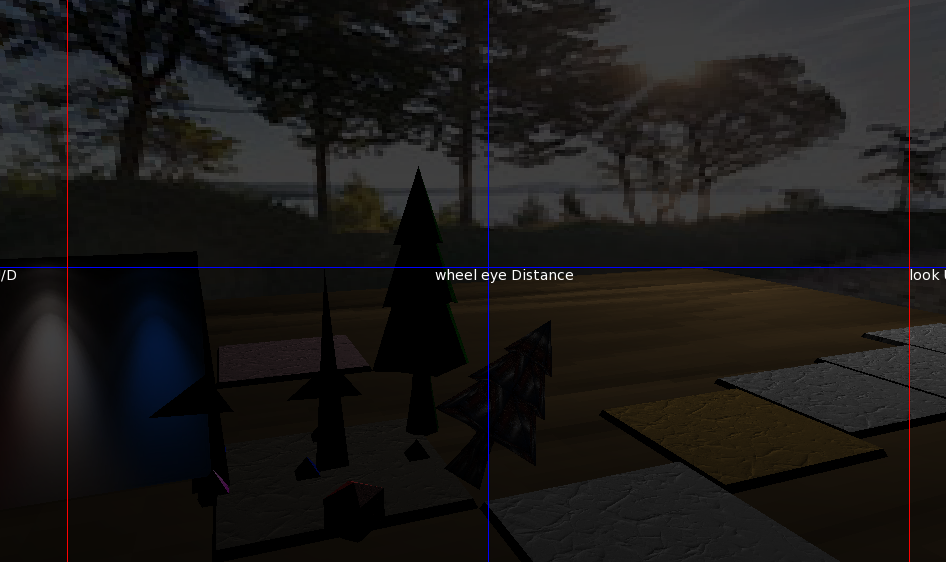
Using some bitmaps for skyglobe, new normal mapping and lighting.
The general look is grey because I have applied a dark grey color to the final output!I’m quite happy with the normals now they work as I wanted. Next step will be to look at stuff like reflection…
it’s always one step forward and two back…
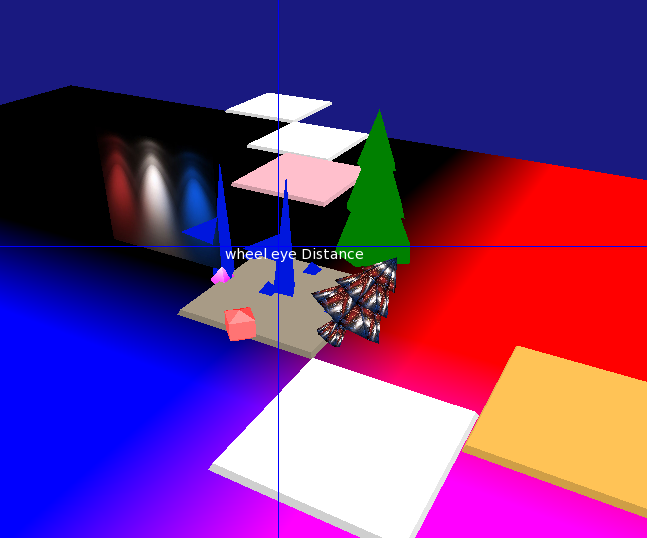
There was a problem with the shaders and incoming bitmaps, so I needed to backtrack a few steps and get the multiple bitmaps working and then the actual world location systems working as well.Here you can see some base objects using different shaders:
– one just flat colors
– one uses a single bitmaps (we’ll call this light as it’s showing a red/white/light image)
– the table is showing the actual world locations in color form for debugging
– and the weird xmas looking tree is showing 3 bitmaps at onceIt’s all debug work, so it’s just a work in progress, but I’m now happy with the results.
I’ll have a look and recompile for windows and get something out soon

isn’t an int usually 32 bit with longint being 64 bits?
be careful of changing how an int works (from current) as something might break. E.G. readint, writeint which are definitely 4 bytes.
Macos compiles are already 64bit with no internal int changes, so shouldn’t windows be the same?
just a thought
It’s an unrealised program called fontmap.
It takes up to 2 charfonts (these are 16×16 bitmaps of characters), plus up to 3 palletes.
You can then add layers. Each layer can be different resolution and stores the results as both palette position (color) and character used.
Layers can be hidden, shown in different offsets allowing for strange map representation like hex maps.The access code to load and manipulate the maps is also very simple, allowing you to decide how to use the data in your own apps.
Which platform are you on mac or win?
The maths is not too hard. getting the opengl right is the difficult thing.
I habit tested it on windows or another mac yet… So I am expecting to do some changes just to make it all work together.Now that you’ve raised it, I just had a thought. You know your original mojo3d test with making a generated maze, that had very bad FPS at the beginning. I might have a go at your code, and use it as a test to see how this one works… I’ll report back to you
add stuff, but don’t break stuff.
small report. Not got the FBO working yet. But got all the base processing sorted:
depth, automatic normals, position, color
Here’s a quick look. basically showing depth darkening, object color and matrix.
Had to do a redesign on the base system to allow highly optimised multi-low poly render.
First let me thanks both Mark and Ethernaut for having patience with me.
I especially liked the references detailing how components work, abstraction, etc. Much clearer now. Thanks Mark.
And yep (to Mark). I will ‘roll my own’ 3d renderer. But not because I didn’t want to use Mojo3d (I did try). It just has a different approach which placed to many restrictions on me experimenting with things.
Thanks Mark, I’ll let you know how I get on. or not. lol
and another thing…. (I’m on a roll here, possibly a ham one?)
Monkey1234567891011121314151617181920"light":{"Class":"game3d.GameObject","Components":[{"CastsShadow":true,"Class":"game3d.LightComponent","Color":[1,1,1,1],"Enabled":true,"Name":"LightComponent","Range":30,"Type":1}],"Name":"light","Parent":"","Position":[10,10,0],"Rotation":[45,90,-0],"Scale":[1,1,1],"Visible":false,"timeOffset":0},Am I the only one that this gives the shudders to?
You are (in essence) abstracting stuff to the point of irrelevance.
This all looks to be about data hiding. What happened to writing code that did something?
So, I load the demo, look at the source (to understand what is going on, to learn from it), the source gives me nothing, just wrappers around data that is further hidden, that I then need to find the source of and then need to get the modules of in the hope it might explain what is going on, but that is a wrapper round a secondary function of a class which has been subclassed and extended (cause the original author thought it would be great to use all privates and not expose anything).
And on it goes.
The key phrase I was taught by very large companies when coding is ‘CLARITY’ and KISS (Keep It Simple Stupid)
and… what is the difference between a component and an entity?
What about plugins and factories, Whilst we are at it I’ve got an old fridge that we could make a module of, stuff it with reverse extends and sell it, etc, etc
Agreed.
There is loads of talk about adding ‘this’ and ‘that’ to the language and NOTHING about how to actually use what is already there. Fibers anyone?
There is a real feeling of ‘feature creep’ going on with Monkey2. Why not concentrate on getting it usable.
There is a danger that it becomes the answer to the question that no-one was interested in!
If you are serious about adoption of Monkey2 by anyone. the real task should be about documentation. and spelling out how thing are done and how they can be done. what are the best ways to do things, etc.
Would be nice to have any feedback on this one. Even if it is ‘Go Away’
Great to hear from you Mark, and that sound a bit better than before.
Whilst I might complain about Monkey2. I love it, but I’m a geek and don’t have problems modifying things when I need to.
Monkey2 for me is uber productive. and I really enjoy dev on the mac and then cross compile on win. I’ve not done an linux apart form some Pi stuff a while back.
I would love to help or contribute (my changes) as wanted. So never be afraid to ask or say ‘bugger off’ lol
-
AuthorPosts